
The Quiet
Poems of Endurance

I returned last night from conducting trauma training for churches in Armenia. I spent a week with Christians ministering to families who had fled from the Nagorno-Karabakh region of Azerbaijan. One little girl I met had become a refugee at the age of eight, having lost her father and brother in the fighting. Her and her mother lived in a small apartment, while her aunt showed me pictures of the house and garden where they used to live.
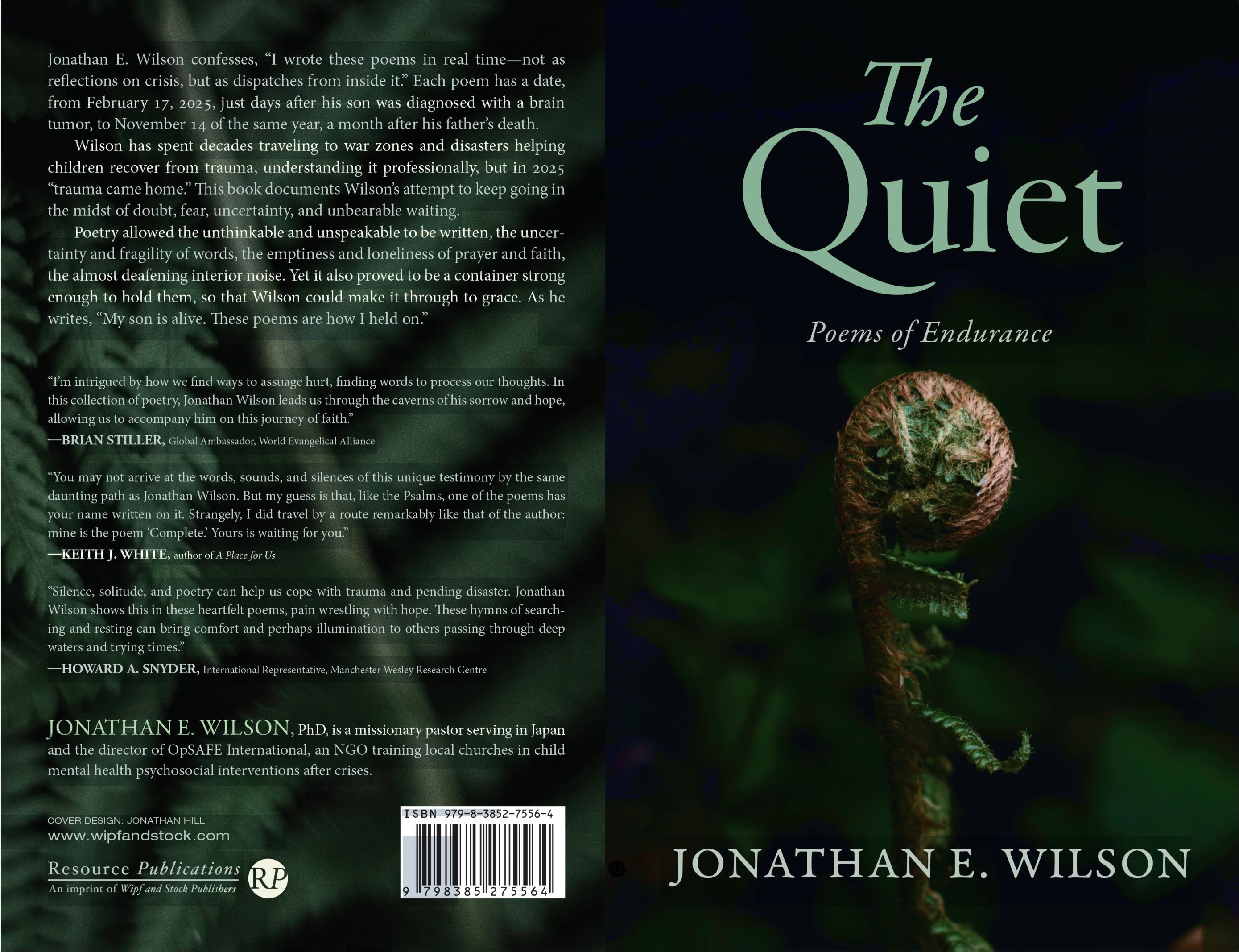
When I arrived home in Tokyo I found waiting for me the cover for a book of poems that I wrote last year as my son underwent multiple operations to remove a brain tumor and my father died. The cover shows a picture of a fiddlehead fern clenched into a tight ball that will slowly unfold. This is one of the images I use in the title poem of the book, entitled “The Quiet”. Here is an excerpt from the first movement of that poem.
I feel that feeling that never
stays completely submerged
but haunts the undergrowth of memories.
Nothing particular, stalking today's particulars,
always ready to burst from the depths,
bleakening what should be perfectly acceptable.
Tasks to be done. People to meet.
Conversations about ordinary things become unbearable.

I take a walk.

As footfall follows footfall, footfalls
find their way to the shady forest trail.
Branches pierced by dappled spears of light,
none reaching far to pierce the gloom
surrounding primordial ferns, curling fronds like hands
clutching to hold something—something
that should have been released long ago.
Perhaps there is nothing left, an ancient memory
dissolved ages ago, leaving behind
only an instinctive impulse
to hold on.
.
In my trauma work with communities affected by disaster and war I often encounter what is a subtext written underneath the hurt and pain that these events occasion. There is obvious loss and grief, but there is also something more. As I went through our family crises last year writing poetry was a way to explore that subtext.
Shared Paths
I was privileged to study under Dr. Keith J. White who is the Director of Mill Grove, a residential community caring for children who have experienced separation and loss. He graciously wrote this endorsement.

Complete

Son questioning
sacrificial offering without a lamb,
obedient march to Moriah
father lifted his eyes on the third day and saw.

Thrown into the sea,
sacrifice to calm its raging storm,
cast out of God’s sight,
yet after three days vomited onto dry land.

Mocked, scourged, crucified,
in my place He died, the sacrifice
that on the third day
makes reconciliation complete.
.
Each poem in this book was written as I was going through the events of last year. The result is not a study of faith from a pastoral or theological perspective. It is instead notes from along the path.
Complete was written on March 9th just weeks after the MRI revealed a 5.5 cm tumor pressing against my son’s brain. Three days later we were seen by Dr. Akihito Kondo, the chief neurosurgeon of Tokyo’s Juntendo University Hospital. Another three days and a room opened up and my son went in to prepare for surgery. Three more days on March 18th, the operation started at 10:00am and lasted until 5:00pm.
There is a subtext beneath all of these poems. I am the one who walks into crisis and confidently equips people to help children as they go through pain. But last year as we went through the worst, I found myself to be the helpless one.
Each poem pushes against this, seeking relief. I am in conversation with dead poets, testing the limits of language to contain what seems unbounded, grasping for words of faith, stretching devotional practice, and learning to sit with the contradictions.