
Well-Worn Tales
Using the power of myth for healing

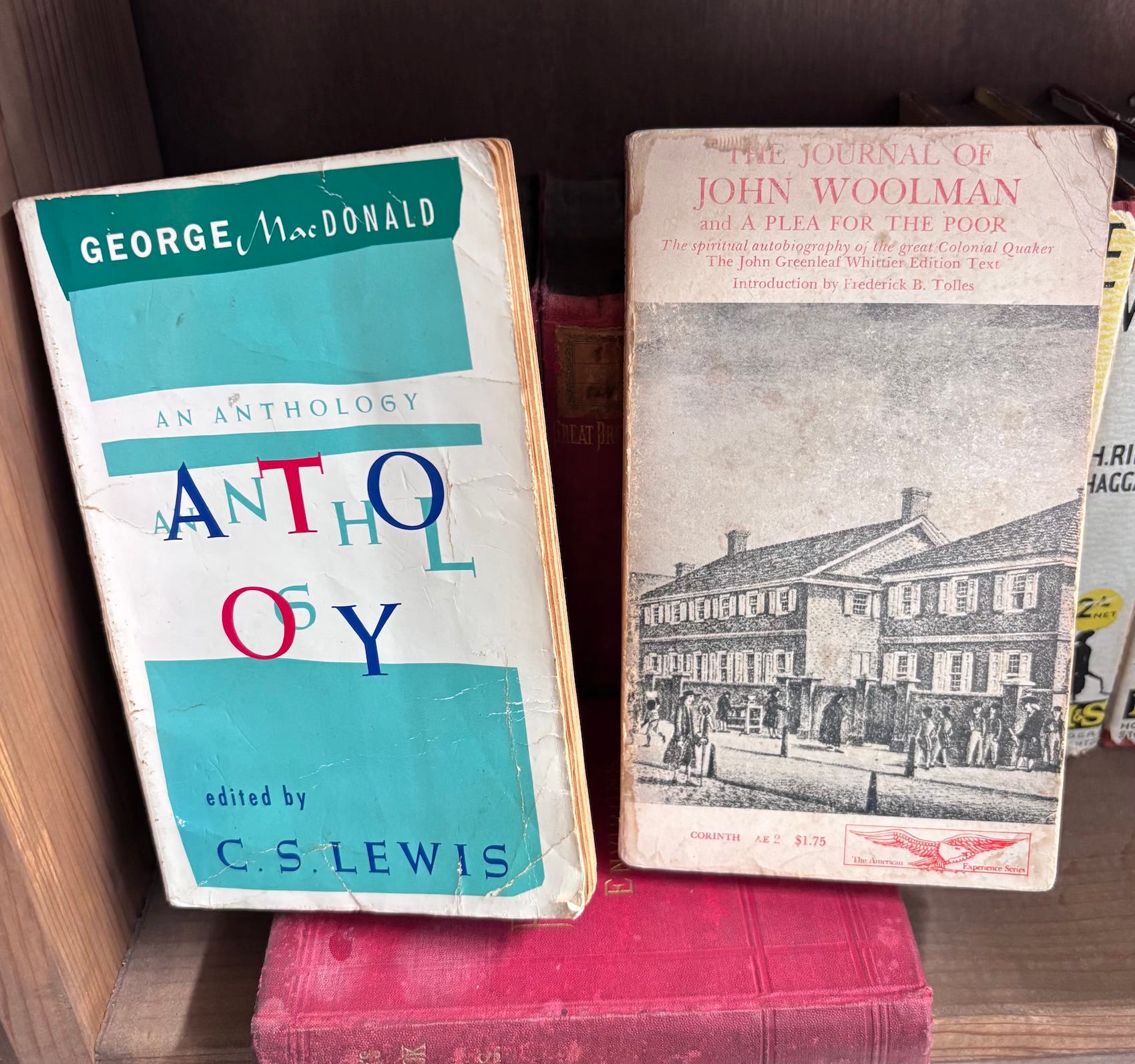
There are three books that continually show up in front of me. I make a habit of re-reading them. One is An Anthology a collection of quotes from George MacDonald edited by C.S. Lewis. Another is The Journal of John Woolman and A Plea for the Poor the spiritual autobiography of the great Colonial Quaker. The third is the Journal of John Wesley. I have been reading and re-reading these books now for decades. Certainly the only book I read more often is my Bible.
George MacDonald
C.S. Lewis called George MacDonald his “master” and said that reading his Phantastes “baptized his imagination” before he ever became a Christian. MacDonald was a 19th century Scottish minister who wrote fantasy and poetry as well as sermons. He was an influence on J.R.R. Tolkien as well, particularly in world-building, seeing the making of fairy tales as an act of creation, which Tolkien would expand upon dramatically with Middle Earth.
An Anthology is actually a collection of quotes about various topics that are largely found in his novels and sermons, but Lewis just provides us the snippet without the world or the characters or any context. But the quotes are rich. In a way these statements are the lifeblood flowing through the veins of these stories.
Lewis writes in the preface, that MacDonald is not really a first-rank or even second-rank writer of words, but that when it came to making myth, “the greatest genius of this kind that I know.” Myth he explains, “gets under our skin, hits us at a level deeper than our thoughts or even our passions.”
Trauma
My humanitarian work is centered on two things. First is mass trauma that happens to communities, things like disasters and conflict. The second is how this affects children and what the church can do to help them recover. I was first concerned how to prepare the church in Japan for disaster response and got trained in chaplain response to crisis. After one such response World Vision Japan asked me how we got volunteers, so I asked them what they wanted to do? They replied with “Child Friendly Spaces.” At the time I had no idea what that was, so they had to explain that it was setting up a supervised play area where children could be watched while their parents were working on getting their lives back together. I asked, “What is the curriculum?” and they said there was none. They just watched the kids as they played.”
This set off a bunch of thoughts in my head and resulted in the design of a 5-day trauma intervention using best-practices for children. I wanted it to be implemented by local churches so used the format of a Vacation Bible School, well-known around the world. However, instead of evangelism, the content was psychological first-aid, with a goal of immediate relief from trauma symptoms like nightmares, clinginess, and refusal to go to school and building up ongoing connections to support in the community.
At the heart of the intervention was a story. Each day introduces a new character with a new trauma recover theme. And this is where myth is powerful.
Myth
By the time we become adults emotions are much more guarded than they are when we are children. We learned the hard way that some emotions are quite dangerous and must be locked away. Trauma is one of the strictest instructors, because dealing with raw emotions is painful. Lewis writes in “Sometimes Fairy Stories May Say Best What’s to be Said” by C.S. Lewis
“But supposing that by casting all these things into an imaginary world . . . Could one not thus steal past those watchful dragons?”
We set our story in Antarctica with a cast of animals so that it could be used anywhere. Each day the children eagerly listen to see what happens next to a little penguin who is separated from his parents when his ice-shelf home falls into the sea.
There is humor and fear, loneliness and sadness, frustration and acceptance, disappointment and courage as he discovers he is not alone, meets friends along the way, and together they survive. The results of this story have now been seen in eleven countries and 60,000 children from Japan’s tsunami to the war in Ukraine.
We follow up with games, crafts, snacks, songs, and dance - each activity giving the small group of five children with their leader a chance to talk about these difficult emotions. But the key is that we are not talking about the child’s emotions. Those are still locked away guarded by watchful dragons. We are talking about the story.
Myth, the story that of course cannot be true, talking animals and all that, creates a buffer between the truth, the reality, and the pain. As we talk about the story each child gives themselves just the right dose of truth. Instead of us deciding how much that child needs, we let the myth steal past the defenses.
By the end of the week, the children see clearly that they are not the only ones who felt that way and they have bonded with their group-mates. They feel safe.
Beyond Allegory
Tolkien was famously against allegory, the mapping of truth to characters in the story. C.S. Lewis does indulge in it with Aslan obviously being an allegory of Christ, but myth does more than allegory. Tolkien put it plainly in the foreword to The Lord of the Rings:
"I cordially dislike allegory in all its manifestations... I much prefer history, true or feigned, with its varied applicability to the thought and experience of readers. I think that many confuse 'applicability' with 'allegory'; but the one resides in the freedom of the reader, and the other in the purposed domination of the author."
When I train trainers to use our story I usually finish with a session where I ask them to take out a paper and pencil and write which of the characters in the story is their favorite and why. Often these trainees have been through the same mass trauma as the children. We then go around the room and ask people to share. Some will identify with the little penguin, others gravitate toward the big walrus who gives him protection, likewise some choose the wise old whale who offers hope, and others resonate with the small seal with fears of her own.
In many ways the parables of Jesus lean in this direction. You can read them as allegory, mapping out what each item means, but their greater power is as myth, stories that allow the reader to take from it what they need, slipping past the “dragons.”
I am indebted to George MacDonald, C.S. Lewis, and J.R.R. Tolkien. Each one moves story in a different way but were shown by MacDonald the power of myth for meaning-making.
This has gotten long so I will save the other books for another time.
“The Quiet: Poems of Endurance” is coming out later this year through Wipf & Stock.